Repair or Replace Your Water Heater in Pueblo?
A water heater rarely fails without warning. Hot water runs out sooner. The tank rumbles. The water looks rusty. A small puddle appears at the base. Each sign tells you something, but none of them alone tells you whether to repair or replace. The choice depends on four things: the age of the heater, the part that failed, the condition of the tank, and the cost of the repair compared with the cost of a new unit. In Pueblo, hard water sits behind many of these choices, because sediment and scale wear a tank faster than soft water does.
Start with the age on the data plate
Start with the age. The age is printed on the data plate on the tank. Published Pueblo-area guidance puts most tank heaters at about 8 to 12 years. That range is not a deadline. A well-kept heater can last longer, and a neglected heater in hard water can fail sooner. Age is a clue, not the whole answer. A heater that is five years old with one failed part is a very different case from a heater that is fourteen years old and has needed two repairs in a year.
Published Pueblo-area guidance gives a useful pattern. A unit under 8 years old with a single failed component is usually worth repairing. Once a heater passes 10 to 12 years, shows rust in the hot water, or needs repeated repairs, replacement is usually the smarter step. A tank shell that leaks is in a category of its own. A shell leak cannot be repaired, and the heater must be replaced. A leak from a fitting or a relief valve is different, and it can often be repaired.
The part that failed decides the repair
Next, look at the part that failed. A thermocouple on a gas heater is a small part with a clear job. It reads the pilot flame and keeps the gas valve open. When it fails, the pilot will not stay lit. A heating element on an electric heater is also a single part, and a meter test shows whether it has failed. A thermostat can be replaced in the same way. These are repairs that make sense when the tank itself is sound. Gas Water Heater Repair in Pueblo covers pilot, thermocouple, and gas valve faults, and the test comes before any part is fitted. A gas valve costs more, and a power vent blower costs more again. The part, and the labor to fit it, shape the repair price.
The condition of the tank, and the anode rod
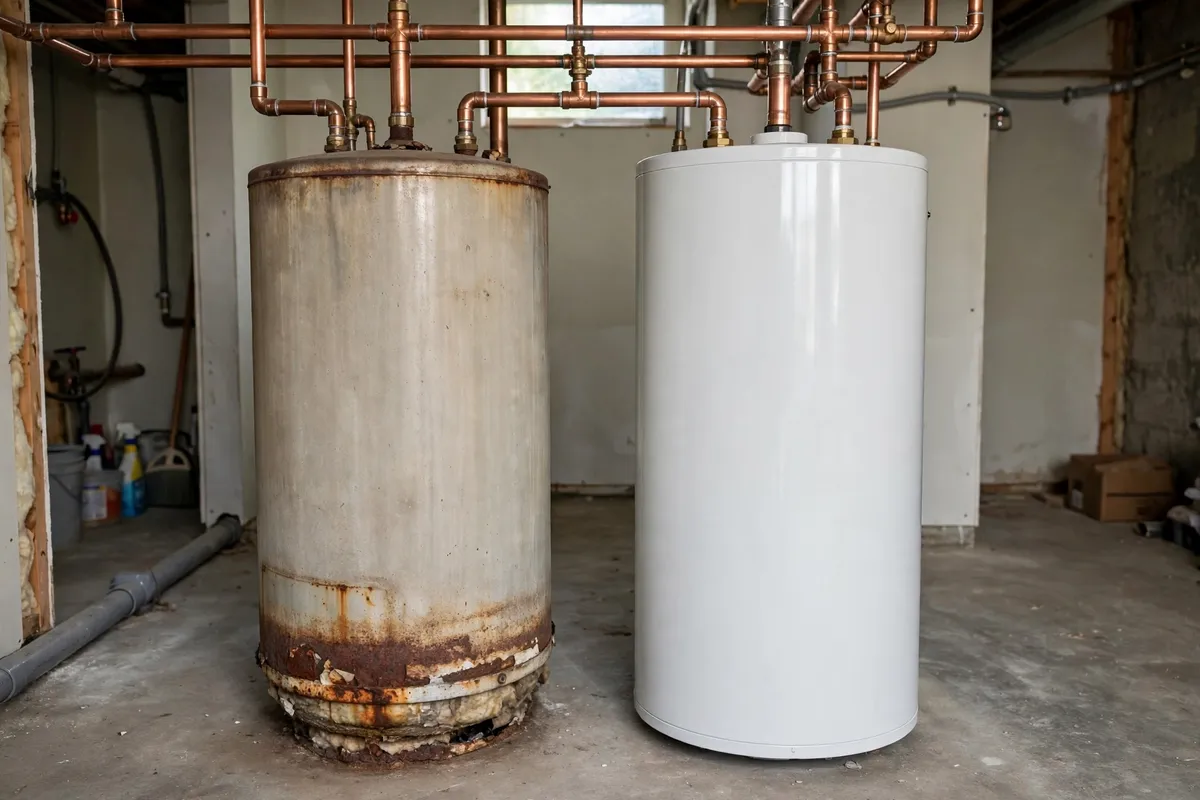
Then look at the condition of the tank. Rusty hot water is a warning that the inside of the tank is corroding. Rust streaks at the base are a warning, too. Sediment is a quieter problem. Minerals from Pueblo's hard water settle at the bottom of the tank. The layer bakes onto the burner or element and insulates it from the water. The heater works harder, recovery slows, and the tank can rumble or pop when it heats. A flush helps a tank that is still sound. A flush does not save a tank that is already leaking from the shell. Water Heater Replacement and Installation is the step for a shell leak.
The anode rod is the part most homeowners never see. It protects the tank from corrosion, and it depletes over time. Material from the United States Department of Energy notes that once the anode rod is depleted, the tank starts to corrode and can develop a leak. A maintenance visit checks the rod and replaces it when it is worn. A rod check is cheap compared with a new tank, and it is one of the best reasons to have a heater looked at before it fails. Water Heater Maintenance and Flush includes the rod check, the flush, and the relief valve check.
Compare repair and replacement prices in the open
Cost is the last piece, and it should be compared in the open. Ask for the repair price and the replacement price side by side when the tank is older. Published Pueblo-area pages list example ranges for the work. Gas repairs are listed at 150 to 800 dollars. Tank replacement is listed at 1,400 to 3,000 dollars on one page and 2,400 to 4,600 dollars on another. Tankless conversion is listed at 6,800 to 9,500 dollars as an example range on that same page. These ranges come from other published pages. They are not this business's prices, and they are not a quote for your home. A 300 dollar repair on a sound young tank is a clear choice. A 700 dollar repair on a rusted fourteen-year-old tank usually is not.
Colorado's 2026 rules for new gas heaters
New gas heaters in Colorado add one more factor. House Bill 23-1161 took effect on 1 January 2026. New gas water heaters sold or installed in Colorado must meet ultra-low NOx limits of 10 nanograms per joule at or below 75,000 BTU per hour, and 14 nanograms per joule above that, or meet current ENERGY STAR certification. The rule applies to new units, not to a working heater already in your home. It does shape the options when replacement is the step. Your replacement options will reflect the units that meet the current rules.
Think about the household, too. A tank that was fine for two people can fall short when a family grows, when a bathroom is added, or when laundry and showers run at the same time. Size is matched to the household, not just to the label on the old tank. A larger tank, a tankless unit sized for peak use, or a heat pump unit in a suitable space are all options, and each one fits a different home. The right choice is the one that matches how your home uses hot water.
There is also the question of timing. A heater older than ten years, a heater that rumbles, or a heater that has needed a repair in the past year is worth a check before it fails. A maintenance visit flushes sediment, checks the anode rod, checks the relief valve and fittings, and gives you a clear picture of where the heater stands. That visit costs less than a flooded floor.
The short answer is simple. Check the age. Find the failed part. Look at the condition of the tank. Compare the repair price with the replacement price. In Pueblo's hard water, sediment and the anode rod are part of every one of those checks. Call Pueblo Water Heater Expert at (719) 677-5212 to talk about your heater. Describe the age, the symptoms, and what you have noticed, or read more about water heater repair in Pueblo, CO. You will hear the options for your home, and the choice will be yours.
Related: Water Heater Replacement and Installation, Gas Water Heater Repair, Electric Water Heater Repair, Water Heater Maintenance and Flush, Tankless Water Heater Installation.
Sources: National Propane Gas Association, Colorado's New Equipment NOx Standards (House Bill 23-1161); Rheem, NOx Emissions Reduction: Path to Clean Air; U.S. Department of Energy material on anode rods, tank flushing, and tankless descaling; NOAA Pueblo climate data (elevation and temperature); Kenna Real Estate, Pueblo Affordable Homes Guide, and ZipDataMaps, Pueblo, CO Neighborhoods; and published Pueblo-area plumbing pages for cost and symptom ranges. No competitor names or links are used on this site.