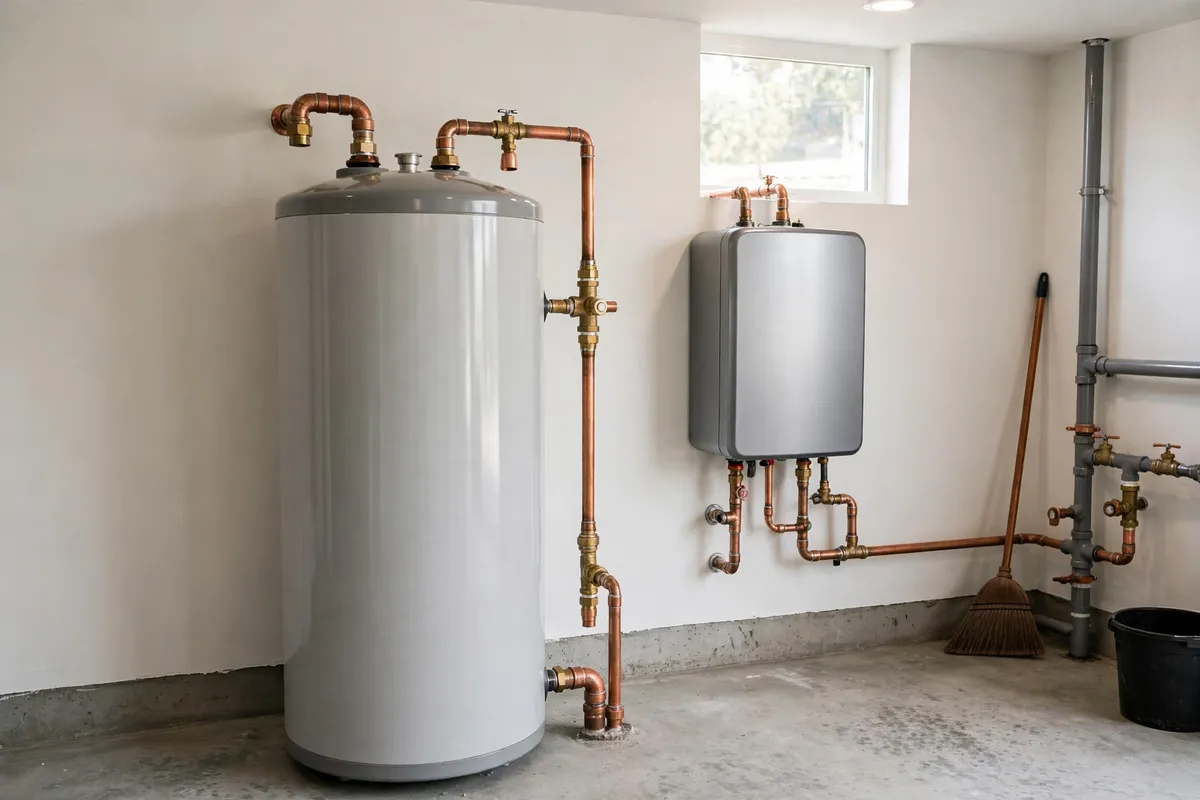
Tank vs. Tankless Water Heaters in Colorado
Tank and tankless water heaters do the same job in different ways. A tank heater keeps a set amount of water hot at all times, usually 40 to 75 gallons in a house. When you use hot water, cold water refills the tank and is heated. Use more than the tank holds, and you wait for it to recover. A tankless heater has no tank. It heats water as it flows through the unit. Open a hot tap and the burner fires. Close the tap and the burner stops. It will not empty, but it can only heat so many gallons per minute at once. Neither type is better for every home. The right choice depends on how your household uses hot water, what your home can support, and what the work will cost.
Cost first: tank vs. tankless
Cost comes first for most homeowners. A tank heater costs less up front and is simpler to replace. A like-for-like tank swap is often done in one visit. A tankless unit costs more to buy and more to install, especially when the gas line or venting needs to be changed. Published Pueblo-area pages list tank replacement at 1,400 to 3,000 dollars on one page and 2,400 to 4,600 dollars on another, and tankless conversion at 3,000 to 6,000 dollars on one page and 6,800 to 9,500 dollars as an example range on another. Those ranges come from other published pages. They are not this business's prices. They show the gap between the two jobs.
Cold winter water changes the sizing
Colorado changes the sizing question. In winter, water enters the house much colder than in summer. A tankless unit has to raise that water more degrees, and that lowers how many gallons per minute it can deliver. A unit sized for summer conditions can fall short in January, when two showers and a dishwasher run at the same time. The fix is to size for the coldest water and for peak use, not for an average day. A tank heater has the same winter problem in a different form. Cold incoming water slows recovery, so a tank that copes in summer can fall short on a cold morning.
Altitude, venting, and the gas line
Altitude matters, too. Pueblo sits at about 4,700 feet. Gas appliances lose some output at elevation, and both tank and tankless gas heaters must be set up for altitude under the manufacturer instructions. The venting must also fit the unit. A tankless unit often needs different venting from the old tank's flue, and condensing models need a condensate drain. The gas line is the other hidden cost. A tankless unit draws a lot of gas when it fires, far more than a typical tank heater. Many existing gas lines, especially in older homes, were not sized for that demand. A tankless unit on an undersized line can cut out during heavy use or never reach its rated output. The gas line is checked before the unit is chosen. Tankless Water Heater Installation in Pueblo starts with that gas line and venting check.
Maintenance is different in hard water
Maintenance is different for the two types, and Pueblo's hard water makes that difference larger. Tanks collect sediment. The minerals in hard water settle at the bottom, insulate the burner or element, and cause rumbling or popping. A flush once a year helps. Tankless heat exchangers collect scale instead. The scale narrows the passages in the heat exchanger, restricts flow, and can cause error codes and fluctuating temperatures. Published Pueblo-area guidance puts tankless descaling at every 12 to 18 months in hard water. Either way, the unit needs regular care — see Water Heater Maintenance and Flush — and the manufacturer instructions for the unit are followed.
Lifespan is often quoted as a reason to switch, and it should be read with care. The United States Department of Energy puts tank heaters at 10 to 15 years and tankless units at more than 20 years for most units. Those are typical figures, not promises for a single home.
Space and power are practical points that decide many jobs. A tank needs floor space in a closet, garage, or basement. A tankless unit mounts on a wall and takes far less space. That matters in a tight utility closet. Power is the other way round. Most tankless units need electricity to run, so they usually do not work in a power outage. Many standard gas tanks keep working without power, because the pilot and burner do not need electricity. If outages matter to you, that point is worth raising when you call.
Colorado's 2026 NOx rule
Colorado law changed the options for new gas heaters in 2026. House Bill 23-1161 took effect on 1 January 2026. New gas water heaters sold or installed in Colorado must meet ultra-low NOx limits of 10 nanograms per joule at or below 75,000 BTU per hour, and 14 nanograms per joule above that, or meet current ENERGY STAR certification. The National Propane Gas Association and Rheem both describe the same limits. The rule applies to new units, not to a working heater already in your home. It does mean that replacement options in 2026 look different from the options a few years ago, for both tank and tankless gas units. Electric and heat pump units are not subject to the NOx limits, because they do not burn gas.
A heat pump water heater is a third option worth knowing about. It is an electric unit that moves heat from the surrounding air into the water. It needs space, air around the unit, and a condensate drain. It does not fit every closet, and it cools the air around it a little as it works. For a home with a suitable space, it is an electric option that avoids gas rules and gas venting altogether. It is covered in more detail in Heat Pump Water Heater Installation.
The decision comes down to four questions. How much hot water does your household use at peak times? How cold is the water coming in during winter? Can your gas line and venting support a tankless unit, and at what cost? And how much does the up-front cost matter compared with the running cost over the life of the unit? Answer those four, and the choice is usually clear. Call Pueblo Water Heater Expert at (719) 677-5212 for the options that fit your home, or read more about water heater repair in Pueblo, CO.
One last point applies to both types. Do not choose on price alone, and do not choose on a sales claim alone. Ask what the unit is sized for, what the gas line and venting work will be, and what maintenance the unit will need in hard water.
Related: Water Heater Replacement and Installation, Gas Water Heater Repair, Electric Water Heater Repair, Water Heater Maintenance and Flush, Tankless Water Heater Installation.
Sources: National Propane Gas Association, Colorado's New Equipment NOx Standards (House Bill 23-1161); Rheem, NOx Emissions Reduction: Path to Clean Air; U.S. Department of Energy material on anode rods, tank flushing, and tankless descaling; NOAA Pueblo climate data (elevation and temperature); Kenna Real Estate, Pueblo Affordable Homes Guide, and ZipDataMaps, Pueblo, CO Neighborhoods; and published Pueblo-area plumbing pages for cost and symptom ranges. No competitor names or links are used on this site.